Systems Thinking & Complexity
A practical pathway for learners who want to see interconnections, map complex problems, understand feedback loops, identify leverage points, and design resilient systems for communities, organizations, policy, and sustainability.
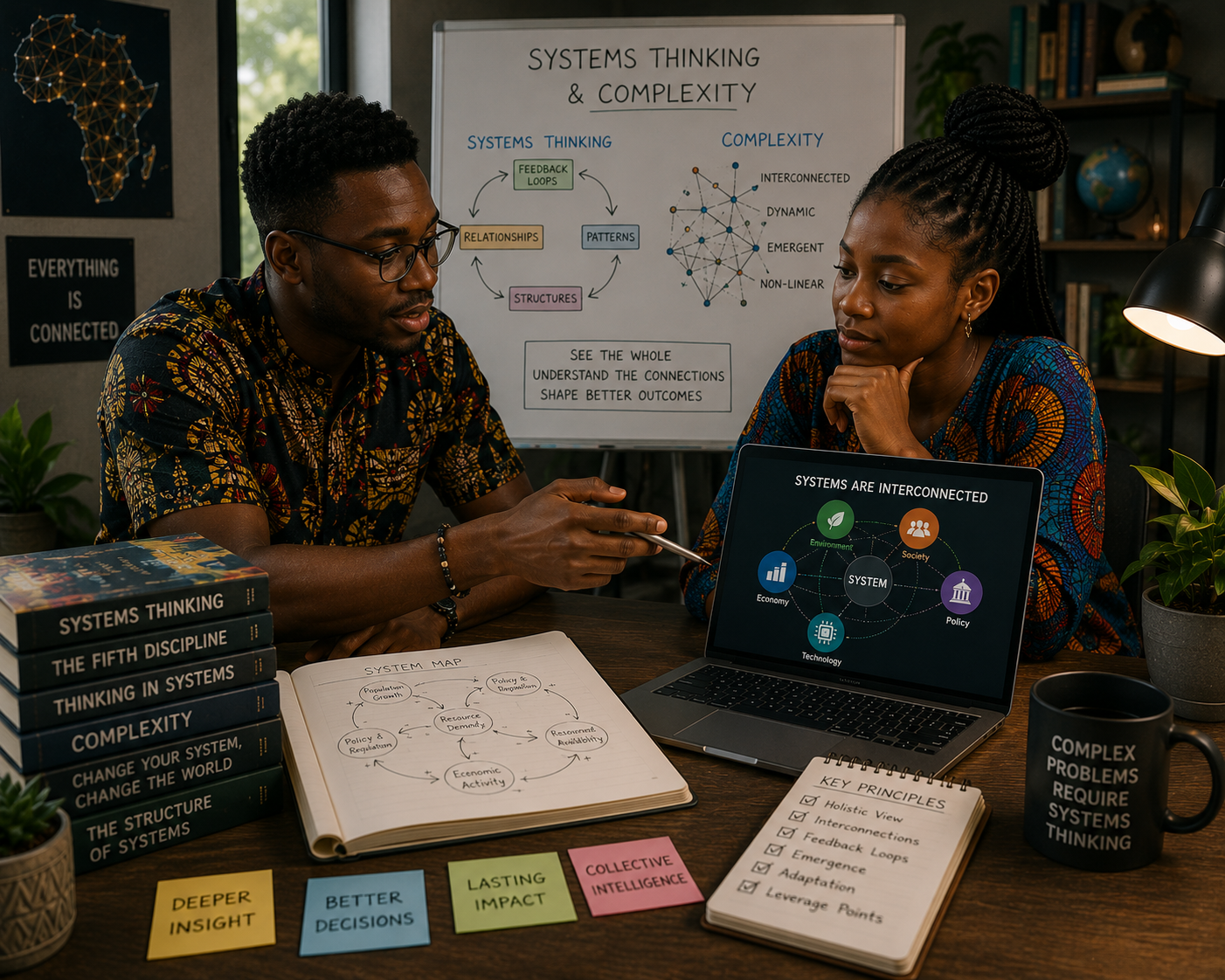
Learn to see the whole system.
This category is designed as a systems lab. Learners begin with interconnections and feedback loops, move into systems mapping and complexity, then advance into modeling, resilience design, systems governance, and large-scale transformation.
Recognize patterns, relationships, boundaries, causes, effects, and hidden structures.
Create systems maps that show actors, flows, feedback loops, and pressure points.
Study complexity, adaptive behavior, scenarios, decision points, and system dynamics.
Identify leverage points, strategies, innovation spaces, and policy opportunities.
Design resilient systems that adapt, recover, learn, and support long-term change.
Beginner Courses
For learners starting with systems thinking, interconnections, feedback loops, resilience, and basic systems mapping.
Introduction to Systems Thinking
Understand systems thinking as a way to see relationships, patterns, and whole problems.
Understanding Systems Everywhere
Explore systems in families, schools, farms, businesses, ecosystems, and communities.
Seeing the Bigger Picture
Learn how to look beyond symptoms and understand the wider structure behind problems.
Understanding Interconnections
Study how people, resources, decisions, institutions, and environments influence one another.
Feedback Loops Explained
Learn reinforcing and balancing feedback loops using simple everyday examples.
Cause and Effect Thinking
Understand direct, indirect, delayed, and circular cause-and-effect relationships.
Systems in Everyday Life
Use systems thinking to understand habits, households, classrooms, markets, and communities.
Systems and Sustainability
Explore how sustainability depends on connected ecological, economic, and social systems.
Introduction to Complexity
Learn why some problems are unpredictable, adaptive, interconnected, and difficult to control.
Food-Energy-Water Systems
Understand how food, energy, and water systems interact in communities and development.
Systems Mapping Fundamentals
Learn basic mapping tools for relationships, actors, flows, drivers, and system boundaries.
Problem Solving with Systems Thinking
Use systems thinking to diagnose root causes and avoid shallow solutions.
Community Systems Basics
Study communities as systems of people, institutions, resources, culture, and decisions.
Environmental Systems
Explore ecosystems, water cycles, climate, biodiversity, land use, and human influence.
Organizational Systems
Understand organizations through roles, incentives, culture, communication, leadership, and processes.
Decision-Making in Systems
Learn how decisions create ripple effects, trade-offs, delays, and unintended consequences.
Systems and Resilience
Understand how systems absorb shocks, adapt, recover, and transform under pressure.
Introduction to Adaptive Thinking
Build flexibility, learning, experimentation, and adjustment for uncertain environments.
Systems Leadership Foundations
Learn leadership that sees patterns, convenes people, and works across boundaries.
Systems Mapping Project
Create a basic systems map of a real community, organization, or sustainability challenge.
Intermediate Courses
For learners ready for complex adaptive systems, systems dynamics, leverage points, resilience, policy, and transformation strategies.
Complex Adaptive Systems
Study systems that learn, adapt, self-organize, and behave unpredictably over time.
Systems Dynamics Fundamentals
Understand stocks, flows, delays, feedback loops, and dynamic system behavior.
Systems Modeling Techniques
Learn practical modeling tools for representing structure, behavior, assumptions, and scenarios.
Feedback Analysis
Analyze reinforcing, balancing, delayed, hidden, and competing feedback loops.
Leverage Points for Change
Identify where small interventions can create meaningful and durable system change.
Organizational Systems Thinking
Analyze organizational culture, workflows, incentives, communication, leadership, and adaptation.
Community Systems Analysis
Study community actors, institutions, resources, power, vulnerabilities, and intervention points.
Environmental Systems Management
Apply systems thinking to ecosystems, water, climate, agriculture, and land-use decisions.
Systems Innovation
Design innovations that respond to system structure, stakeholders, constraints, and feedback.
Systems and Policy
Understand how policies influence systems through incentives, rules, institutions, and trade-offs.
Systems-Based Problem Solving
Use systems tools to diagnose complex problems and design more durable interventions.
Resilience Thinking
Study robustness, adaptability, transformation, thresholds, recovery, and learning systems.
Adaptive Leadership
Lead through uncertainty, experimentation, learning, stakeholder engagement, and adaptive action.
Scenario Planning
Create scenarios to explore uncertainty, risks, decisions, futures, and strategic options.
Strategic Systems Mapping
Create advanced maps showing actors, incentives, flows, bottlenecks, loops, and leverage points.
Systems Decision-Making
Make decisions by considering trade-offs, delays, uncertainty, stakeholders, and system effects.
Sustainability Systems Analysis
Analyze sustainability challenges through social, ecological, technical, and economic relationships.
FEWS Systems Thinking
Apply systems thinking to food, energy, water, climate, and livelihood relationships.
Systems Transformation Strategies
Design strategies that shift patterns, incentives, relationships, governance, and long-term outcomes.
Systems Portfolio Project
Compile maps, feedback loops, scenarios, leverage points, and systems intervention plans.
Advanced Courses
For advanced learners designing resilient systems, governance strategies, futures thinking, innovation labs, and large-scale transformation.
Advanced Systems Thinking
Apply advanced systems concepts to complex social, ecological, organizational, and policy challenges.
Complexity Science
Study emergence, nonlinearity, adaptation, uncertainty, networks, thresholds, and self-organization.
Systems Dynamics Modeling
Build and interpret dynamic models using stocks, flows, feedback, and scenarios.
Adaptive Systems Leadership
Lead adaptive systems through learning, collaboration, experimentation, sensemaking, and resilience.
Systems Change Strategies
Design long-term change strategies that shift structures, relationships, incentives, and narratives.
Systems Architecture Design
Design system structures, relationships, processes, governance, flows, and feedback mechanisms.
Complex Problem Solving
Approach wicked problems using systems inquiry, experimentation, collaboration, and learning cycles.
Systems Governance
Study governance across institutions, stakeholders, rules, accountability, coordination, and adaptation.
Systems and Public Policy
Analyze policy systems, implementation gaps, feedback effects, institutional behavior, and public outcomes.
Socio-Ecological Systems
Understand linked human-natural systems, resilience, adaptation, governance, and sustainability.
Resilience Systems Design
Design systems that anticipate shocks, absorb disruption, adapt, recover, and transform.
Strategic Foresight and Futures Thinking
Use futures tools to explore uncertainty, signals, scenarios, strategy, and long-term transformation.
Systems Innovation Labs
Design collaborative labs for experimentation, prototyping, stakeholder learning, and systems change.
Complexity and Decision-Making
Make decisions under uncertainty using adaptive strategies, scenarios, feedback, and judgment.
Systems Research Methods
Use systems inquiry, mapping, modeling, stakeholder analysis, and mixed evidence approaches.
Large-Scale Systems Transformation
Study how large systems shift through leadership, policy, innovation, culture, and coordination.
Global Systems Challenges
Analyze climate, migration, food security, inequality, health, energy, and water as global systems.
Building Resilient Systems
Build resilience through redundancy, diversity, learning, adaptation, networks, and preparedness.
Systems Leadership Practicum
Apply systems leadership to a real challenge through mapping, convening, strategy, and reflection.
Capstone: Designing a Resilient System
Create a complete resilient system design with maps, feedback loops, scenarios, and intervention plans.
Systems transformation pathway
Learners progress from seeing interconnections to designing resilient systems, using systems mapping, feedback analysis, leverage points, adaptive leadership, and transformation strategies.
Related categories
Continue learning through connected LIFEWS Academy pathways.
Start your systems thinking and complexity pathway.
Begin with systems thinking foundations, learn to map feedback loops, and progress toward resilient systems design and transformation leadership.