Youth STEM & Robotics
A hands-on technology pathway for young innovators learning science, coding, robotics, electronics, AI, drones, smart agriculture, renewable energy, and climate technology.
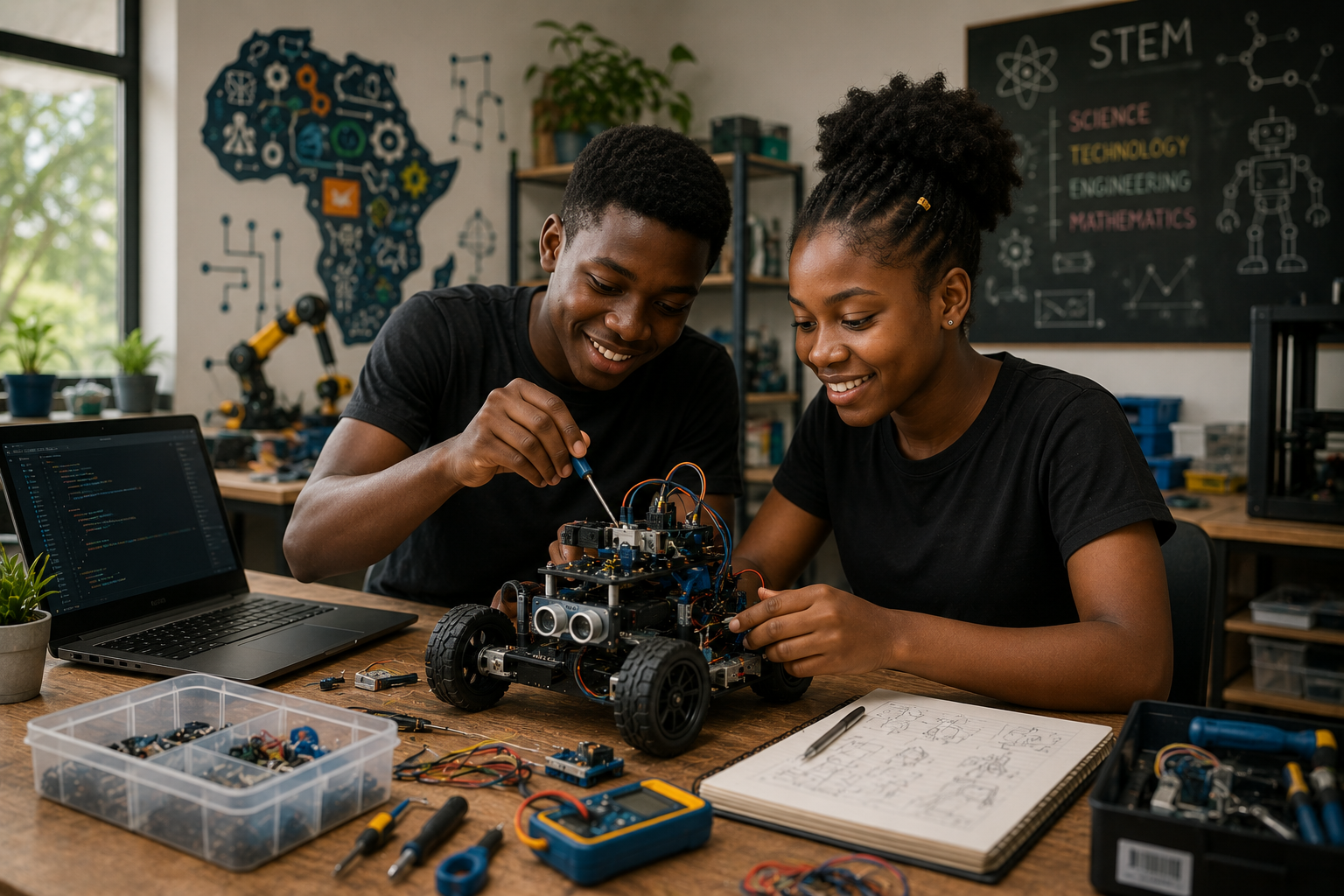
From curiosity to smart technology.
This category is designed as a youth innovation lab. Learners begin with STEM foundations, move into coding and robotics, then advance into AI, drones, IoT, renewable energy engineering, smart agriculture, and technology entrepreneurship.
Discover science, robotics, electronics, climate, energy, water, and everyday technology.
Create simple machines, robots, sensors, circuits, coding projects, and STEM experiments.
Use coding, microcontrollers, Scratch, Arduino, IoT, AI, and data tools.
Prepare for robotics competitions, innovation challenges, design showcases, and team projects.
Design smart solutions for farms, water systems, energy access, climate resilience, and communities.
Beginner Courses
For young learners starting with STEM, robotics, coding, simple machines, science experiments, and creativity.
Introduction to STEM
Understand science, technology, engineering, and mathematics as tools for solving real problems.
Science in Everyday Life
Explore how science appears in homes, schools, farms, water, energy, weather, and health.
Introduction to Robotics
Learn what robots are, how they work, and how young innovators can build them.
Building Your First Robot
Create a simple robot while learning parts, movement, power, sensors, and teamwork.
Understanding Sensors and Motors
Learn how sensors detect the world and motors help robots move and respond.
Introduction to Coding
Understand basic coding ideas such as commands, sequences, loops, conditions, and debugging.
Scratch Programming for Beginners
Use Scratch to create animations, games, interactive stories, and simple logic projects.
Problem-Solving Through STEM
Use observation, questioning, testing, and teamwork to solve simple real-world challenges.
Engineering Design Basics
Learn the design cycle: identify, imagine, plan, create, test, improve, and share.
Introduction to Artificial Intelligence
Understand AI through simple examples, smart tools, pattern recognition, and responsible use.
Renewable Energy STEM Projects
Build simple projects that demonstrate solar energy, wind energy, batteries, and clean power.
Water Science Experiments
Explore water quality, filtration, flow, storage, conservation, and water security experiments.
Agricultural STEM Projects
Use STEM to understand seeds, soil, irrigation, sensors, microgreens, and smart farming.
Climate Science for Youth
Learn climate basics through experiments, weather observation, carbon thinking, and action projects.
Building Simple Machines
Create simple machines using levers, wheels, pulleys, gears, ramps, and basic engineering.
Introduction to Electronics
Understand circuits, batteries, switches, LEDs, wires, safety, and basic electronic components.
STEM Creativity and Innovation
Use imagination, design, experimentation, and teamwork to create new STEM ideas.
Teamwork in STEM Projects
Learn collaboration, roles, communication, project sharing, and respectful problem-solving.
STEM Career Exploration
Explore careers in engineering, robotics, AI, agriculture, energy, water, data, and climate technology.
Beginner Robotics Challenge
Complete a simple robotics challenge using design, building, testing, teamwork, and presentation.
Intermediate Courses
For learners ready for Arduino, sensors, IoT, drones, coding projects, competitions, and innovation portfolios.
Robotics Programming Fundamentals
Program robot movement, inputs, outputs, loops, decisions, and simple control behaviors.
Arduino for Young Innovators
Use Arduino boards to control LEDs, sensors, motors, buzzers, and small projects.
Microcontrollers and Embedded Systems
Understand how small computers control devices, machines, robots, and smart systems.
Engineering Design Challenges
Work through structured challenges that require testing, prototyping, teamwork, and iteration.
Intermediate Coding Projects
Create interactive projects using variables, conditions, functions, data, and user input.
Robotics Sensors and Control Systems
Use sensors, feedback, calibration, and simple control logic to improve robot behavior.
Introduction to Internet of Things (IoT)
Learn how connected devices collect data, communicate, and support smart systems.
STEM Research Fundamentals
Learn questions, experiments, data collection, evidence, conclusions, and presentation.
Renewable Energy Engineering Projects
Design practical STEM projects using solar, wind, batteries, and energy efficiency.
Water Technology Projects
Build and test water filtration, monitoring, pumping, storage, and conservation systems.
Smart Agriculture Technologies
Explore sensors, irrigation, data, microgreens, automation, and farm innovation tools.
Climate Technology Innovation
Design youth projects for climate monitoring, adaptation, resilience, and awareness.
STEM Entrepreneurship
Turn STEM ideas into simple products, services, prototypes, and community solutions.
Drone Technology Fundamentals
Understand drone parts, flight principles, safety, applications, and mapping uses.
AI and Machine Learning for Youth
Explore AI concepts, training data, predictions, patterns, fairness, and youth projects.
Data Science for Beginners
Collect, organize, visualize, and explain data from STEM experiments and projects.
Robotics Competition Preparation
Prepare for competition rules, robot testing, teamwork, documentation, and presentation.
Innovation and Design Thinking
Use empathy, ideation, prototyping, testing, and feedback to solve real problems.
STEM Leadership Development
Build confidence, communication, teamwork, responsibility, mentoring, and project leadership.
Intermediate Robotics Portfolio
Compile coding files, robot designs, project photos, research notes, and competition reflections.
Advanced Courses
For advanced learners designing autonomous systems, AI applications, drones, smart water systems, and STEM ventures.
Advanced Robotics Engineering
Design complex robotic systems using mechanics, electronics, programming, and testing.
Artificial Intelligence Applications
Apply AI concepts to education, agriculture, energy, water, climate, and robotics projects.
Machine Learning Fundamentals
Understand training data, models, classification, prediction, evaluation, and responsible ML.
Computer Vision for Robotics
Explore image sensing, object detection, pattern recognition, and robot vision applications.
Autonomous Systems Design
Design systems that sense, decide, move, respond, and operate with limited human input.
Drone Engineering and Applications
Study drone design, mapping, monitoring, agriculture, delivery, safety, and field applications.
Internet of Things Systems Design
Build connected sensor systems for farms, water, energy, climate, and smart schools.
Advanced Electronics and Circuits
Work with circuit design, components, breadboards, power, signals, and troubleshooting.
Renewable Energy Engineering
Design energy projects using solar systems, batteries, loads, efficiency, and resilience thinking.
Climate Technology Innovation Lab
Create technology solutions for climate monitoring, adaptation, risk reduction, and awareness.
Agricultural Robotics
Explore robots for planting, monitoring, irrigation, harvesting, sensors, and farm automation.
Smart Water Systems Engineering
Design water monitoring, filtration, pumping, storage, irrigation, and IoT water systems.
Data Analytics and Visualization
Analyze and visualize data from sensors, experiments, robotics, farms, and climate projects.
Engineering Research Methods
Plan engineering investigations, collect data, test prototypes, and present evidence-based results.
STEM Innovation Incubator
Develop STEM ideas into prototypes, pitch decks, demonstrations, and community solutions.
Technology Entrepreneurship
Turn technology projects into ventures, products, services, competitions, and youth enterprises.
Future Technologies and Society
Discuss AI, robotics, drones, biotech, climate tech, ethics, jobs, and social change.
Robotics Competition Masterclass
Prepare advanced competition strategies, documentation, engineering notebooks, testing, and presentation.
Leadership in STEM Innovation
Lead STEM clubs, teams, labs, competitions, mentorship, and community innovation programmes.
Capstone: Design and Build a Smart Technology Solution
Create a complete smart technology solution using design, coding, sensors, testing, and presentation.
Innovation challenge pathway
Learners move from basic STEM confidence to robotics projects, then into advanced smart technology solutions for agriculture, water, energy, climate, and community resilience.
Related categories
Continue learning through connected LIFEWS Academy pathways.
Start the youth STEM and robotics pathway.
Begin with STEM foundations, build simple robots, learn coding and electronics, and progress toward smart technology solutions for real-world challenges.